

Why do we need heat dissipation design for LED aluminum substrates?
Effects of high temperature on electronic products: decreased insulation performance; damaged components; thermal aging of materials; cracking of low-melting-point welds and detachment of solder joints.
Effects of temperature on devices: generally, a rise in temperature reduces resistance values; high temperature shortens the service life of capacitors; high temperature degrades the insulation materials of transformers and choke coils, whose allowable temperature should generally be below 95 C; excessively high temperature also changes the alloy structure of solder joints, with the IMC layer thickening, solder joints becoming brittle, and mechanical strength decreasing; a rise in junction temperature causes the current gain of a transistor to increase rapidly, which raises the collector current and further increases the junction temperature, eventually leading to device failure.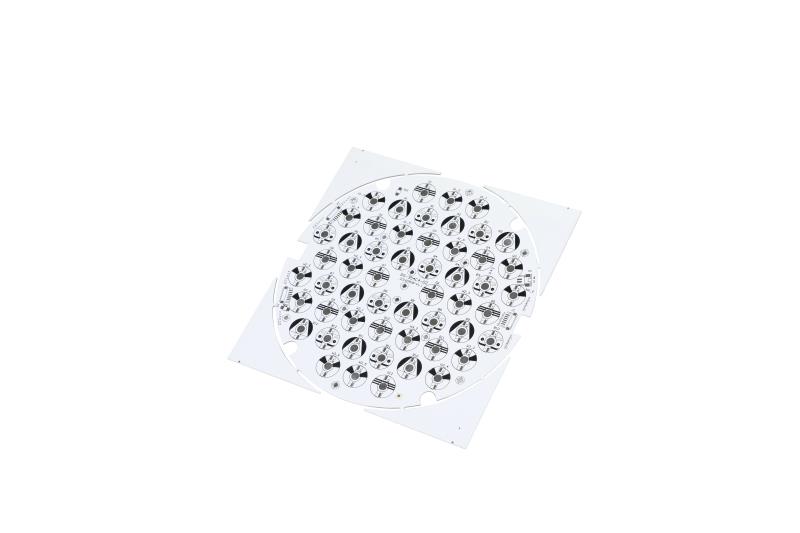
The purpose of thermal design is to control the temperature of all electronic components inside a product so that, under the working environment conditions, it does not exceed the maximum temperature specified by standards and specifications. The calculation of the maximum allowable temperature should be based on the stress analysis of components and be consistent with the product reliability requirements and the failure rate allocated to each component.
Based on the above issues, today we will mainly discuss the heat dissipation of LED aluminum substrates and further analyze heat dissipation design.
Heat dissipation of LED aluminum substrates is the biggest headache for LED manufacturers. A heat-dissipating aluminum substrate is a medium that provides thermal conduction, increasing the bottom area of the LED aluminum substrate and enlarging the heat dissipation area. It is mainly composed of a copper foil circuit, ceramic powder and polymer, and an aluminum substrate. In the LED industry, this heat-dissipating aluminum substrate features high thermal conductivity, safety, and environmental protection. The following introduces the use of aluminum substrates. Thanks to its high thermal conductivity and good heat dissipation, it can effectively export internal heat. An aluminum substrate is a special metal-based copper-clad laminate with good thermal conductivity, electrical insulation, and mechanical properties. In design, the PCB should be placed as close as possible to the aluminum alloy base to reduce the thermal resistance of the potting component.
Generally, the circuit layer (i.e., copper foil), which forms a printed circuit after etching, connects the various parts of each component and usually needs a large current-carrying capacity, so thick copper foil of 35 to 280 μm should be used. The insulation layer is the core technology of an aluminum substrate. It is usually made of a special polymer filled with specialty ceramics, featuring low thermal resistance, good viscoelasticity, strong resistance to thermal aging, and the ability to withstand mechanical and thermal stress.
The insulation layer of a high-performance aluminum substrate uses this technology, giving it good thermal conductivity and high-strength electrical insulation. The metal base is the supporting member of the aluminum substrate and has very high thermal conductivity; it is usually aluminum, though copper may also be used (copper can provide better thermal conductivity), and it is suitable for conventional machining such as drilling, punching, and cutting. Compared with other materials, PCB materials have incomparable advantages and are suitable for surface mounting of power components. This design requires no heat sink and offers small size, good heat dissipation, good insulation, and good mechanical performance. By now you can see the role of heat dissipation design for LED aluminum substrates, right? If anything is still unclear, feel free to consult our company!












