

Aluminum substrate ink is the ink printed on LED aluminum substrates and mainly serves as solder mask protection. Ordinary aluminum substrate ink is white solder mask ink, with black silkscreen legend ink printed on top.
 What is an aluminum substrate?
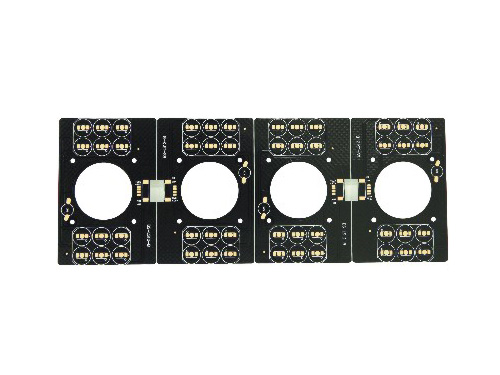
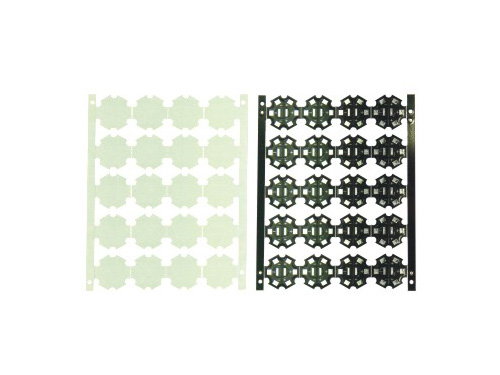
An aluminum substrate is a metal copper-clad laminate with better heat dissipation than conventional PCBs. A common single-sided board consists of a three-layer structure, namely the circuit layer, the insulating layer, and the metal base layer. It is commonly found in LED lighting products. It has a front and a back: the white side is used for soldering, while the other side shows the natural metallic aluminum and is generally coated with thermal grease before contacting the heat-conducting part. There is also, of course, a relatively special ceramic board.
For high-end applications, aluminum substrates can also be designed as double-sided boards with a structure of circuit layer, insulating layer, aluminum base, insulating layer, and circuit layer. Aluminum substrates rarely have multilayer versions; a multilayer aluminum substrate can be made by laminating a conventional single-layer board with an insulating layer and an aluminum base.
An LED aluminum substrate is also a type of PCB, except that its printed base material is an aluminum alloy, whereas conventional circuit boards used fiberglass as the material. However, because LED light sources generate more heat than some components, the circuit boards used in LED luminaires are generally aluminum substrates.
What are the general requirements for aluminum substrate white ink?
Sulfur-free and environmentally friendly: white ink inevitably contains some sulfur (mainly concentrated in sulfhydryl groups). In LED lamps and backlight sources, especially COB packages, silver plating is used in some areas on the one hand, and the phosphor itself contains silver on the other; over time, sulfur reacts with silver to form silver sulfide (black), causing light decay that appears as the lamp dimming. Ag + S --- Ag2S. Therefore, the requirement on sulfur content for aluminum substrate white ink is higher than that for ordinary PCB solder mask white ink.
An aluminum substrate is also a type of circuit board; it simply requires faster heat conduction, so its reflectivity must be good.

Why do aluminum substrates use white solder mask ink?
Aluminum substrates are generally used as backlight boards and LED circuit boards, with light reflection being one of their major functions. The higher the reflectivity of the white ink, the brighter the lighting effect. At present, those on the market who recognize this are mainly Korean and Japanese orders; in addition, television backlight sources have already adopted high-reflectivity white ink in large quantities.
The basic reflectivity of aluminum substrate solder mask white ink on the market today is 68-75%, including Taiyo solder mask ink WT02 with a reflectivity of 73.6%. Reflectivity must be measured with a dedicated instrument. If the white ink reflectivity reaches 80%, taking a television as an example, a typical backlight board fitted with 6 LED chips using high-reflectivity solder mask white ink can use one fewer LED chip, or can use 0.5 W chips instead of 0.7 W chips without affecting brightness.

Classification of aluminum substrate white ink
At present, aluminum substrate solder mask white ink is divided into yellowish white and bluish white, that is, warm white and cool white. Manufacturing solder mask white ink is different from green ink and involves considerable technical difficulty. Under normal conditions, the resin and the white pigment (titanium dioxide) both turn yellow at a high temperature of 210 degrees; most factories use a blue pigment (color-light blue) to neutralize the yellow so that the whiteness remains good after high temperature, but in essence this greatly reduces the reflectivity and brightness of the aluminum substrate white ink.











