

LED aluminum substrate mainly serves as the heat output medium between the LED die and the system circuit board, and is bonded to the LED die through processes such as wire bonding, eutectic bonding or flip-chip. For heat dissipation considerations, the LED aluminum substrates on the market are mainly ceramic substrates. Circuit preparation methods can be broadly divided into three types: thick-film ceramic substrates, low-temperature co-fired multilayer ceramic substrates and thin-film ceramic substrates.
In traditional high-power LED components, a thick-film or low-temperature co-fired ceramic substrate is usually used as the die heat dissipation substrate, and the LED die is then bonded to the ceramic substrate by gold wire bonding. This gold wire connection limits the effectiveness of heat loss along the electrode contact. Therefore, major manufacturers at home and abroad are all working to solve this problem.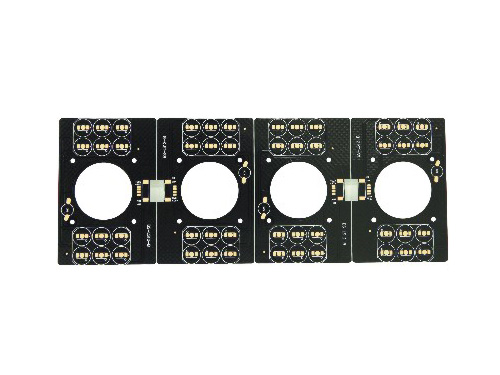
There are two solutions. One is to find a substrate material with a high heat dissipation coefficient to replace aluminum oxide, including silicon substrates, silicon carbide substrates, anodized aluminum substrates or aluminum nitride substrates. The semiconductor characteristics of silicon and silicon carbide substrate materials pose serious challenges at this stage, and anodized aluminum substrates are prone to cracking because the anodic oxide film lacks sufficient strength, which limits their practical application. Therefore, the more mature and generally accepted approach at present is to use aluminum nitride as the heat dissipation substrate.
However, its current limitation is that aluminum nitride substrates are not suitable for the traditional thick-film process (the material must undergo atmospheric heat treatment at 850℃, which causes reliability problems with silver paste printing). Therefore, the circuits of aluminum nitride substrates need to be prepared as thin films. The thin-film process on aluminum nitride substrates greatly accelerates the efficiency of transferring die heat through the substrate material to the system circuit board, thereby greatly reducing the burden of conducting heat through the metal wires to the system circuit board and achieving a high heat dissipation effect.
The products of aluminum substrate manufacturer Mingshihai Electronics are mainly used in aerospace, medical, automotive, communications, power supplies and rail transit; in lighting they are mainly used in miner's lamps, street lights, tunnel lights, panel lights, landscape lighting fixtures and stage lights. We will do our utmost to become your high-quality partner!












