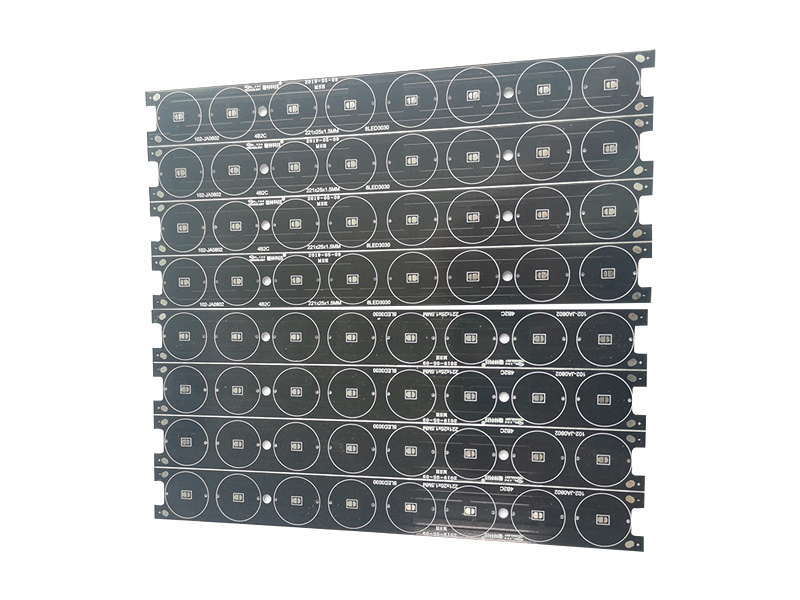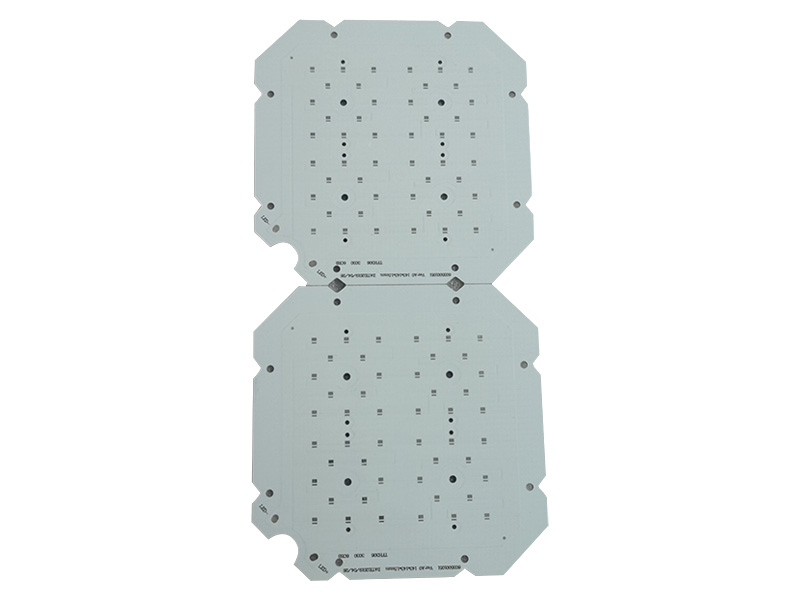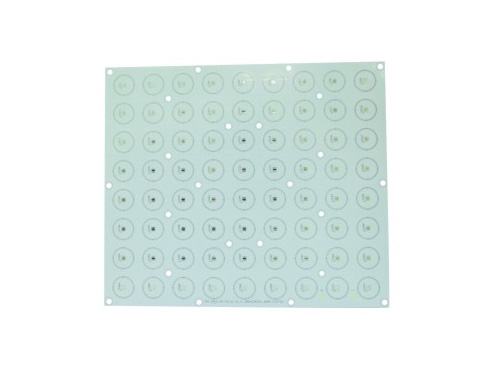
Aluminum substrate circuit board is a unique metal-based copper-clad laminate with good thermal conductivity, electrical insulation performance, and machining properties.
I. Features of aluminum substrate circuit boards
Surface mount technology (SMT) is used;
Extremely effective handling of heat diffusion in the circuit design;
● Lower the product operating temperature, increase power density and reliability, and extend product life;
● Reduce product size and lower hardware and assembly costs;
● Replace fragile ceramic substrates to improve mechanical durability.
II. Structure of aluminum substrate circuit boards
An aluminum-based copper-clad laminate is a metal circuit board material composed of copper foil, a thermally conductive insulation layer, and a metal base. Its structure is divided into three layers:
Circuit layer: equivalent to the copper-clad laminate of a conventional PCB.
Insulation layer: the insulation layer is a low-thermal-resistance, thermally conductive insulating material. A thickness of 0.003" to 0.006" inches is the core calculation for aluminum-based copper-clad laminates and is UL-recognized.
Base layer: it is a metal base, usually aluminum or copper, such as aluminum-based copper-clad laminates and conventional epoxy glass cloth laminates.
The circuit layer (i.e., copper foil) is usually etched into a printed circuit to connect the various components of the module. Generally the circuit layer needs a large current-carrying capacity, so thicker copper foil should be used, typically 35 μm to 280 μm. The insulation layer is the core technology of an aluminum substrate; it is usually made of a special polymer filled with specialty ceramics, featuring low thermal resistance, good viscoelasticity, resistance to thermal aging, and the ability to withstand mechanical and thermal stress. The high-performance aluminum substrate insulation layer of our company uses this technology, giving it excellent thermal conductivity and high-strength electrical insulation. The metal base layer is the load-bearing member of the aluminum substrate and requires high thermal conductivity; it is generally an aluminum plate, and a copper plate may also be used (a copper plate provides better thermal conductivity), suitable for conventional machining such as drilling, punching, and cutting.
PCB materials offer advantages that other materials cannot match, and are suitable for SMT surface mounting of power components.
No heat sink is needed; the size is greatly reduced, with good heat dissipation, good insulation, and good mechanical performance.
III. Applications of aluminum substrate circuit boards:
Application field: power hybrid integrated circuits (HIC).
1. Audio equipment: input and output amplifiers, balanced amplifiers, audio amplifiers, preamplifiers, power amplifiers, etc.
2. Power equipment: switching regulators, DC/AC converters, SW regulators, etc.
3. Communication electronic equipment: high-frequency amplifiers, filter circuits, transmitter circuits.
4. Office automation equipment: motor drives, etc.
5. Automotive: electronic regulators, igniters, power controllers, etc.
6. Computers: CPU boards, floppy disk drives, power supply units, etc.
7. Power modules: inverters, solid-state relays, rectifier bridges, etc.
8. Lamps: with the promotion of energy-saving lamps, a variety of energy-efficient and attractive LED lamps have become popular in the market, and the aluminum substrates used in LED lamps have begun to be applied on a large scale.
IV. Cooling knowledge for aluminum substrate circuit boards
The aluminum-based PCB consists of a circuit layer (copper foil layer), a thermally conductive insulation layer, and a metal substrate layer. The circuit layer needs a large current-carrying capacity, so thick copper foil should be used, generally 35 μm to 280 μm in thickness. The insulation layer is the core technology of a PCB aluminum substrate; it is usually made of a special polymer filled with special ceramic components, with low thermal resistance, good viscoelasticity, resistance to thermal aging, and the ability to withstand mechanical and thermal stress. High-performance PCB aluminum substrates such as IMS-H01, IMS-H02, and LED-0601 use this technology to achieve good thermal conductivity and high-strength electrical insulation. The metal substrate is the supporting member of the aluminum substrate and requires high thermal conductivity; it is generally an aluminum plate, while a copper plate (which can provide better thermal conductivity) is suitable for conventional machining such as drilling, punching, and cutting. Process requirements include gold plating, tin plating, OSP anti-oxidation, immersion gold, and lead-free ROHS processes.