

PCB aluminum substrate is a metal circuit board material composed of copper foil, a thermally conductive insulating layer, and a metal base. Its structure is divided into three layers:
Circuit Layer: equivalent to the copper-clad laminate of an ordinary PCB, with a circuit copper foil thickness from 1 oz to 10 oz.
Insulating Layer: the insulating layer is a low-thermal-resistance, thermally conductive insulating material. A thickness of 0.003 to 0.006 inches is the core calculation method for aluminum-based copper-clad laminates and has been recognized by UL.
Base Layer: it is a metal base material, usually aluminum or copper, comparable to aluminum-based copper-clad laminates and conventional epoxy glass cloth laminates. This PCB aluminum substrate consists of a circuit layer, a thermally conductive insulating layer, and a metal base layer. The circuit layer (i.e., copper foil) is usually etched into a printed circuit to connect the various components of the module. Generally, the circuit layer needs a large current-carrying capacity, so thick copper foil should be used, typically 35 μm to 280 μm. The thermally conductive insulating layer is the core technology of PCB aluminum substrates; it is usually made of a special polymer filled with special ceramics, featuring low thermal resistance, good viscoelasticity, resistance to thermal aging, and the ability to withstand mechanical and thermal stress. High-performance PCB aluminum substrates such as IMS-H01, IMS-H02, and LED-0601 use this technology to achieve good thermal conductivity and high-strength electrical insulation. The metal base is the supporting member of the aluminum substrate and requires high thermal conductivity; it is generally an aluminum plate, though copper plates may also be used (copper plates provide better thermal conductivity), and it is suitable for conventional machining such as drilling, punching, and cutting.
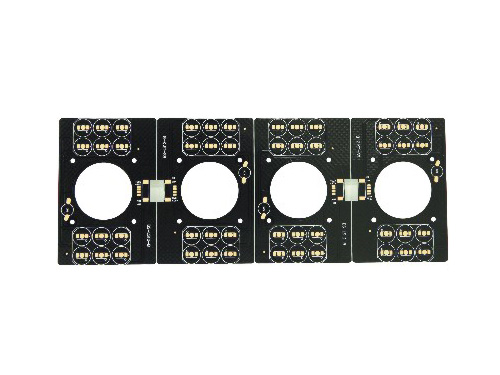
PCB materials offer advantages that other materials cannot match. They are suitable for SMT surface-mount technology for power components. No heat sink is required, the volume is greatly reduced, heat dissipation is excellent, thermal insulation is good, and mechanical performance is strong.
Thermal conductivity, also referred to as the coefficient of thermal conductivity, is a physical quantity that expresses a material's ability to conduct heat. When the perpendicular distance between isothermal surfaces is 1 m and the temperature difference is 1°C, it is the amount of heat (kcal) that passes through an area of 1 m² in 1 hour due to heat conduction. Its unit is kW/(m·h·℃). If a substrate material is required to have greater heat dissipation capability, the substrate used must have a higher thermal conductivity. If thermal insulation through the base material is required, the lower the thermal conductivity of the base material, the better the effect.
Thermal resistance of aluminum substrates: a quantitative description of an object's thermal conductivity can be expressed by thermal conductivity or by another characteristic parameter, "thermal resistance". Relevant literature holds that thermal conductivity is suitable for characterizing homogeneous materials, while for a substrate composed of multiple materials, its thermal performance is better described quantitatively by thermal resistance. In the heat conduction mode, the difference in surface temperature between the two sides of an object (called the temperature difference) is the driving force of heat transfer. Thermal resistance (Rr) equals this temperature difference (T1-T2) divided by the heat flux (P); therefore, the smaller the thermal resistance of the substrate material, the higher its thermal conductivity.
Aluminum substrate models and parameters: aluminum substrates on the market come in three thicknesses: 1.0 mm, 1.5 mm, and 2.0 mm. The basic parameters are the standard type and the high-thermal-conductivity type. The general type typically has a thermal conductivity of 1.0 or above (the base thermal conductivity of the aluminum substrate). The high-conductivity type adds a thermally conductive layer; this material is more expensive and the process is more complex (up to 3.0 or above). Another important parameter is withstand voltage: the standard version is generally between 500 V and 2500 V (depending on board quality), while premium versions can reach above 3000 V, or can be customized (up to 7000 V).












