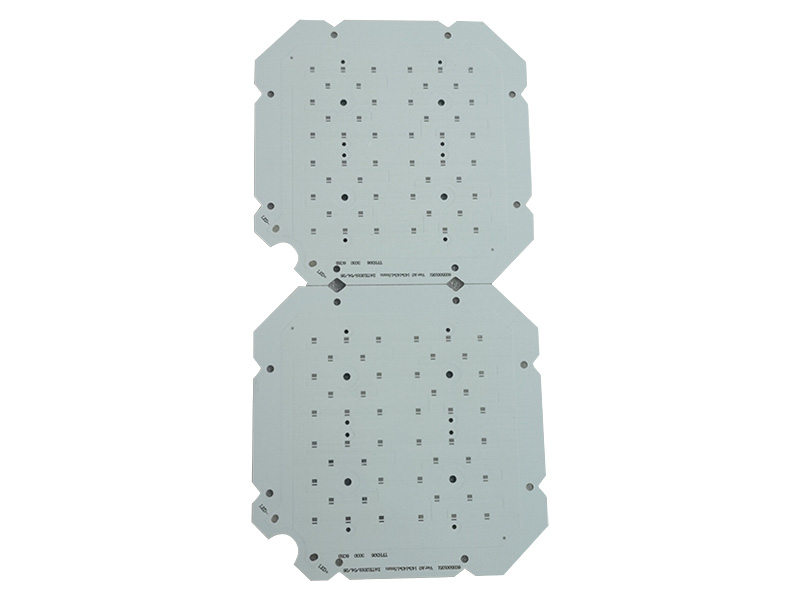
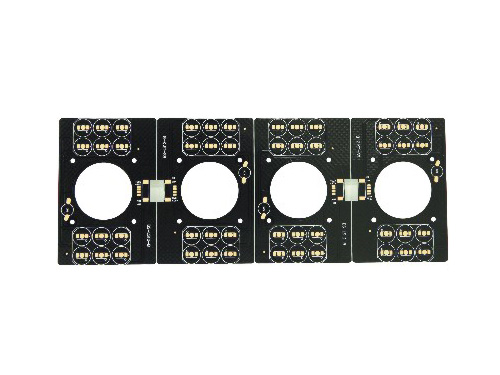
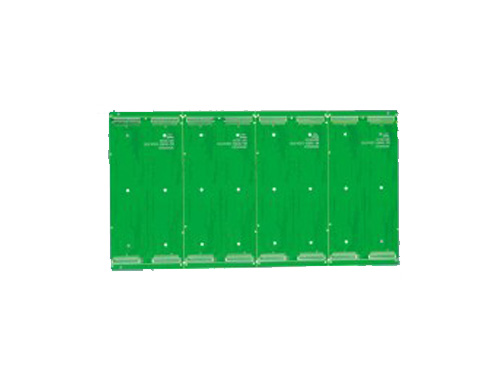
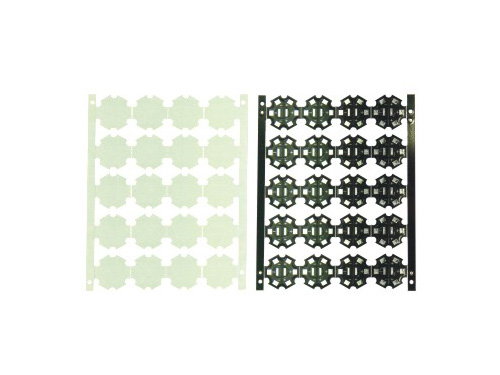
Circuit Layer: equivalent to the copper-clad board of ordinary PCB, with copper foil thickness from 1oz to 10oz.
Insulation Layer: The insulation layer is a low-thermal-resistance thermal insulating material. Thickness: 0.003" to 0.006" is the core measurement value of aluminum-clad copper board, which has passed UL certification.
Base Layer: Metal substrate, usually aluminum or copper. Aluminum-clad copper laminates and traditional epoxy glass cloth laminates, etc. PCB aluminum substrate is composed of circuit layer, thermal insulation layer, and metal base layer. The circuit layer (i.e., copper foil) is usually etched to form a printed circuit so that the components are connected to each other. Under normal circumstances, the circuit layer is required to have a large current-carrying capacity, so thicker copper foil should be used. The copper foil thickness is generally 35μm ~ 280μm. The thermal insulating layer is the core technology of PCB aluminum substrates. It is generally composed of a special polymer film. LEDs use special ceramics, which have small thermal resistance, good viscoelasticity, resistance to thermal aging, and can withstand mechanical and thermal stress. High-performance PCB aluminum substrates such as ims-h01, ims-h02, and led-0601 use this technology for their insulation layer, giving them extremely excellent thermal conductivity and high-strength electrical insulation. The metal base is the supporting component of the aluminum substrate, requiring high thermal conductivity. Generally, it is an aluminum plate, but a copper plate can also be used (which provides better thermal conductivity) and is suitable for conventional mechanical processing such as drilling, punching, and cutting.
PCB materials have unmatched advantages compared with other materials. Suitable for surface mounting of power components. Without a radiator, the volume is greatly reduced, the heat dissipation effect is excellent, and the insulation and mechanical properties are good. Without a radiator, the volume is greatly reduced, the heat dissipation effect is excellent, and the insulation and mechanical properties are good.
Thermal conductivity: Thermal conductivity, also known as thermal conductance coefficient, is a physical quantity representing the thermal conductivity of a material. When the vertical distance of the isothermal surface is 1m and the temperature difference is 1°C, the heat (kcal) passing through a 1m2 area within 1h due to heat conduction. The unit is kilowatt/meter·h·°C [kw/(m·h·°C)]. If the substrate is required to provide thermal insulation, the lower the thermal conductivity of the substrate, the better.
Thermal resistance of PCB aluminum substrates: The thermal conductivity of an object can be quantitatively described by its thermal conductivity coefficient or another characteristic parameter "thermal resistance." Some monographs believe that thermal conductivity is suitable for characterizing the thermal conductivity of homogeneous materials, while as a composite substrate, its thermal conductivity is more suitable for quantitative description by thermal resistance. In the case of heat conduction, the difference or temperature difference between the two surface temperatures of the object is the driving force of heat transfer. Thermal resistance is equal to this temperature difference (T1-T2) divided by the heat flow (P). Therefore, the smaller the thermal resistance of the substrate material, the higher its thermal conductivity.
PCB aluminum substrate models and parameters: According to the general demand for aluminum substrates in the market, they can be divided into three thicknesses of 1.0mm, 1.5mm, and 2.0mm. The basic parameters are ordinary and high thermal conductivity. The thermal conductivity of the ordinary type is generally above 1.0 (the basic thermal conductivity of aluminum substrate). The high thermal conductivity type adds a thermal conductive layer on this basis. The material is expensive and the process is complex, but the thermal conductivity performance is superior, generally 1.5-2.0, and can be customized as needed (up to 3.0). Another important parameter is the withstand voltage: the ordinary board is between 500V and 2500V (depending on the board quality), and excellent boards can reach above 3000V, and can also be customized (up to above 7000V).