1. Surface Mount Technology (SMT) is adopted;
2. Very effective treatment of heat diffusion in circuit design schemes;
3. Lower product operating temperature, improve product power density and reliability, extend product life;
4. Reduce product size and lower hardware and assembly costs;
5. Replace fragile ceramic substrates to improve mechanical durability.
II. LED aluminum substrate structure
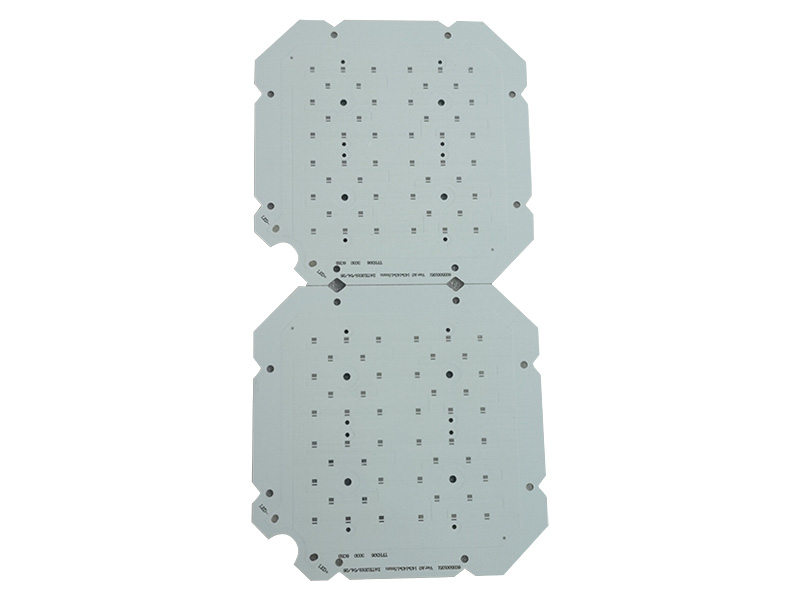
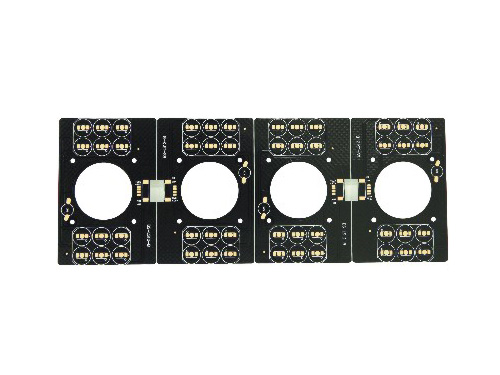
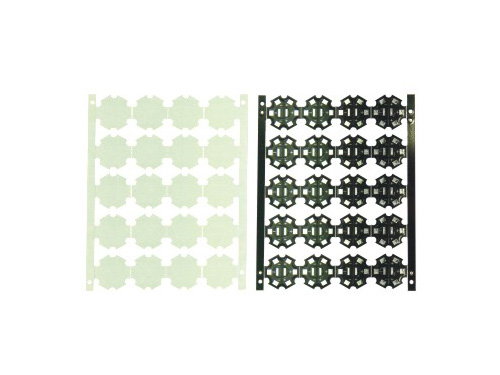
Aluminum-clad copper foil board is a metal circuit board material composed of copper foil, thermal insulating layer, and metal substrate. Its structure is divided into three layers:
Circuit Layer: equivalent to the copper-clad board of ordinary PCB, with copper foil thickness from 1oz to 10oz.
Dielectric Layer: The insulation layer is a low-thermal-resistance thermal insulating material.
Base Layer: It is a metal substrate, usually aluminum or copper. Aluminum-clad copper laminates and traditional epoxy glass cloth laminates.
The circuit layer (i.e., copper foil) is usually etched into a printed circuit to connect the various components of the device. Generally, the circuit layer requires a large current-carrying capacity, so thicker copper foil should be used. The thickness is generally 35μm ~ 280μm; the insulation layer is the core technology of the aluminum substrate. It is usually a special polymer filled with special ceramics. With low thermal resistance, good viscoelasticity, and resistance to thermal aging. It can withstand mechanical and thermal stress.
High-performance aluminum substrates use this technology for the thermal insulating layer, giving them excellent thermal conductivity and high-strength electrical insulation. The metal base layer is the supporting component of the aluminum substrate, requiring high thermal conductivity. It is generally an aluminum plate. A copper plate can also be used (which provides better thermal conductivity), suitable for conventional processing such as drilling, punching, and cutting. PCB materials have advantages that other materials cannot match. Suitable for surface mounting SMT technology of power components. No radiator is needed, the volume is greatly reduced, the heat dissipation effect is good, the insulation performance is good, and the mechanical performance is good.
III. Use of LED aluminum substrates:
Application: Power hybrid IC (HIC).
1. Audio equipment: input, output amplifiers, balanced amplifiers, audio amplifiers, preamplifiers, power amplifiers, etc.
2. Power equipment: switching regulators, DC/AC converters, SW regulators, etc.
3. Communication electronic equipment: high-frequency amplification, filter circuits, reporting circuits.
4. Office automation equipment: motor drives, etc.
5. Automotive: electronic regulators, igniters, power controllers, etc.
6. Computers: CPU boards, floppy disk drives, power supply units, etc.
7. Power modules: inverters, solid-state relays, rectifier bridges, etc.
Shenzhen Mingshihai Electronics Co., Ltd. specializes in producing high-thermal-conductivity high-power LED aluminum-based circuits, double-sided aluminum-based circuits, single/double-sided copper-based circuits, thermal-decoupled copper-based circuits, ceramic circuits, and glass circuits for ten years. We welcome new and old customers to consult and discuss related issues at any time!