

The aluminum substrates produced by aluminum substrate manufacturers are mostly used in LED lamps. So what manufacturing standards apply during the production of aluminum substrates?
The aluminum substrates produced by aluminum substrate manufacturers are often used for power devices with high power density, so the copper foil is relatively thick. If copper foil of 3 oz or more is used, the etching of thick copper foil requires engineering design compensation for line width; otherwise, the line width will be out of tolerance after etching.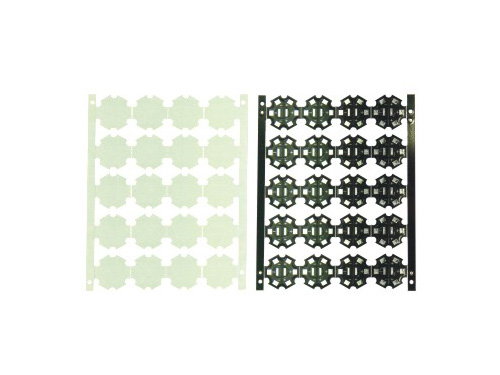
During PCB processing, the aluminum base surface of the aluminum substrates produced by aluminum substrate manufacturers must be protected in advance with a protective film; otherwise, certain chemicals will corrode the aluminum base surface and cause damage to the appearance. Moreover, the protective film is easily scratched, creating gaps, which requires that boards be placed in racks throughout the entire PCB processing operation.
The above has explained two manufacturing standards in the aluminum substrate production process of aluminum substrate manufacturers. Now let us explain the remaining manufacturing standards in the production process.
The milling cutters used for routing fiberglass boards produced by aluminum substrate manufacturers have relatively low hardness, while those used for aluminum substrates have high hardness. During processing, the cutter rotates fast when milling fiberglass boards, while for aluminum substrates the speed is at least two-thirds slower.
For computer-controlled edge milling of fiberglass boards produced by aluminum substrate manufacturers, the machine's own heat dissipation system is sufficient; however, when processing aluminum substrates, additional alcohol cooling must be applied to the router head.
Aluminum substrate manufacturers encounter many different difficulties during the production of aluminum substrates. Let us now explain the first difficulty.
When aluminum substrate manufacturers use mechanical processing: after drilling aluminum substrates, no burrs are allowed inside the holes or along the hole edges, because burrs will affect the withstand voltage test. The milling of the aluminum substrate outline is a very difficult operation. For punching the outline, high-grade molds are required; mold making is highly skillful and is also one of the difficulties in producing aluminum substrates. After the outline is punched, the edges must be very neat, free of any burrs, and must not damage the solder mask at the board edges. Usually a compound die is used, with holes punched from the circuit side and the outline punched from the aluminum side; when the circuit board is punched, the force is shear from above and pull from below, and so on — all of these are matters of skill. After punching the outline, the board warpage should be less than 0.5%.
Aluminum substrate manufacturers encounter many different difficulties during the production of aluminum substrates. The above explained the difficulties arising from mechanical processing; now let us explain the second difficulty.
Throughout the entire aluminum substrate production process, aluminum substrate manufacturers must not scratch the aluminum base surface: touching the aluminum base surface by hand, or contact with certain chemicals, will cause surface discoloration and blackening, which are absolutely unacceptable; some customers will not accept re-polishing of the aluminum base surface either. Therefore, avoiding any scratching or contact with the aluminum base surface throughout the whole process is one of the difficulties in producing aluminum substrates. Some companies adopt a passivation process, while others apply a protective film both before and after hot air leveling (tin spraying); there are many small techniques, and every manufacturer has its own approach.
Aluminum substrate manufacturers encounter many different difficulties during the production of aluminum substrates. The above explained two difficulties arising during production; now let us explain the third difficulty.
When aluminum substrate manufacturers conduct high-voltage testing on aluminum substrates: telecommunication power supply aluminum substrates require 100% high-voltage testing; some customers require direct current, others alternating current, with voltage requirements of 1500 V and 1600 V and durations of 5 seconds and 10 seconds, and 100% of the printed boards are tested. Any dirt on the board surface, burrs in holes and along the aluminum base edges, jagged circuit traces, or the slightest damage to the insulation layer can cause fire, leakage or breakdown during the high-voltage test. Boards that delaminate or blister during the withstand voltage test are all rejected.











