

As a raw material, LED aluminum substrates are metal-based copper-clad laminates with good heat dissipation. They are board-like materials made by impregnating electronic glass fiber cloth or other reinforcing materials with resin, or using a single resin as the insulating bonding layer, then coating copper foil on one or both sides and hot-pressing. They are called copper-clad laminated LED aluminum substrates, or aluminum-based copper-clad laminates for short.
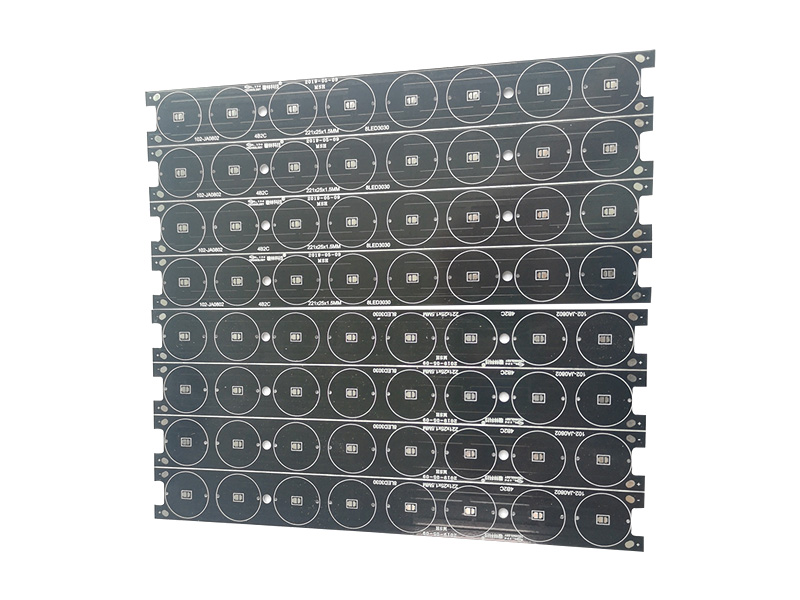
LED aluminum substrates
Performance introduction of LED aluminum substrates.
1. Excellent heat dissipation performance.
LED aluminum substrate copper-clad laminates have excellent heat dissipation performance, which is the most prominent feature of this type of laminate. PCBs made from them can not only effectively prevent the operating temperature rise of the components and substrate mounted on them, but also quickly dissipate the heat generated by power amplifier components, high-power components, large circuit power switches and other components. In addition, due to their low density, light weight (2.7g/cm), oxidation resistance and low price, they have become the most widely used and most consumed composite board among metal-based copper-clad laminates. The saturated thermal resistance of insulated LED aluminum substrates is 1.10℃/W and the thermal resistance is 2.8℃/W, which greatly increases the fusing current of copper traces.
LED aluminum substrates
2. Improved processing efficiency and quality.
LED aluminum substrate copper-clad laminates have high mechanical strength and toughness, far superior to rigid resin copper-clad laminates and ceramic substrates. They enable the manufacture of large-area printed boards on metal substrates, and are especially suitable for mounting heavy components on such substrates. In addition, LED aluminum substrates also have good flatness and can be assembled on the substrate by hammering, riveting, or by bending and twisting along the non-wiring portions of the PCB made from the LED aluminum substrate, which traditional resin copper-clad laminates cannot do.
3. High dimensional stability.
All copper-clad laminates have thermal expansion (dimensional stability) problems, especially thermal expansion in the board thickness direction (Z-axis), which affects the quality of metallized holes and circuits. The main reason is that different materials have different linear expansion coefficients; for example, copper, while the linear expansion coefficient of epoxy glass fiber cloth substrate is 3. The large difference in linear expansion between them easily leads to differences in thermal expansion of the substrate, causing copper traces and metallized holes to break or be damaged. However, the linear expansion coefficient of LED aluminum substrates lies in between, far smaller than that of ordinary resin substrates but closer to that of copper substrates, which helps ensure the quality and reliability of printed circuits.












