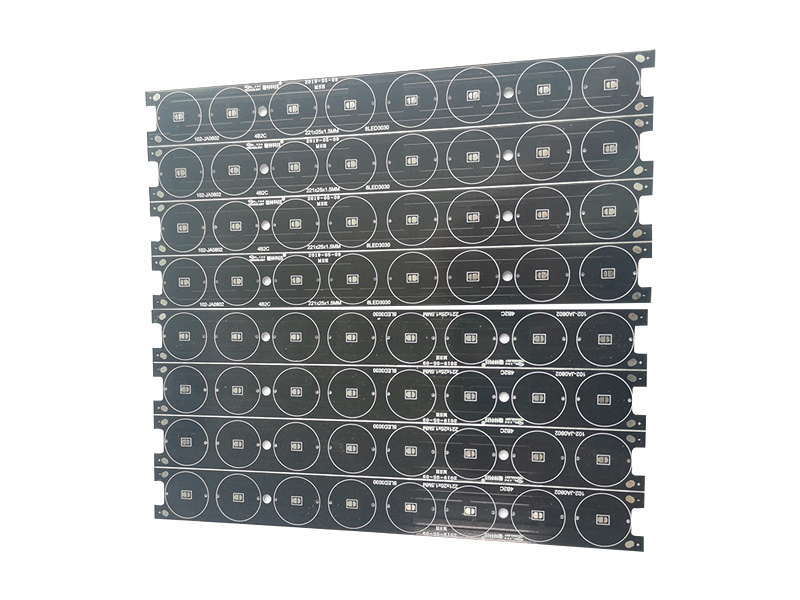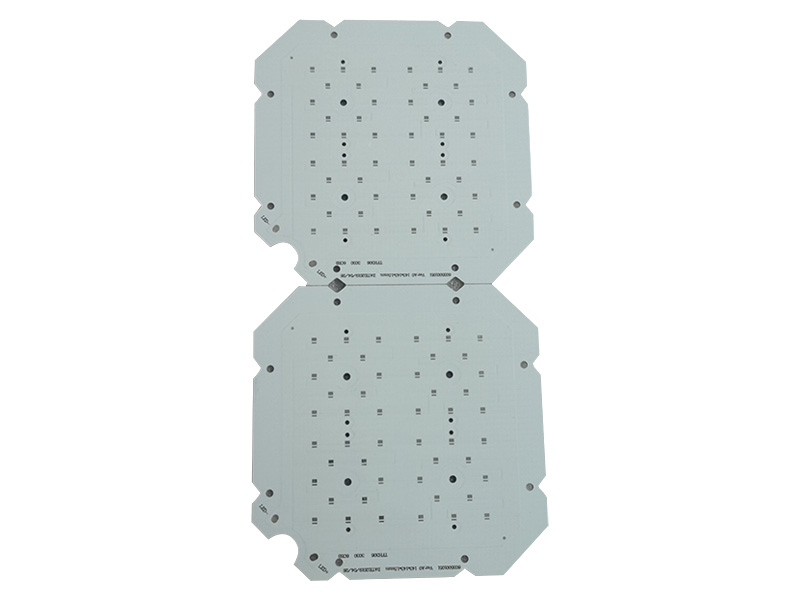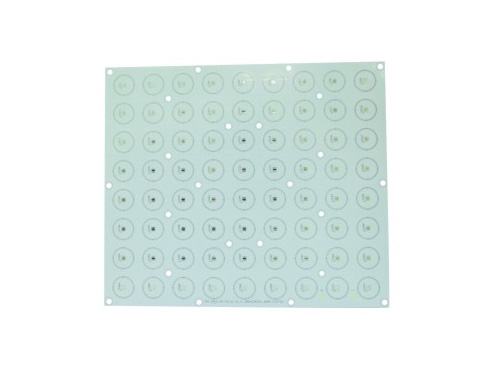
Ordinary glass fiber PCBs have relatively poor heat dissipation. Ceramic PCBs are relatively stable and do not deform easily in high-temperature, high-humidity environments, but they are expensive and are often used in advanced products. So what if the product is not so high-end — for example, a large-area, high-power LED light board that is relatively inexpensive yet still requires very good heat dissipation? Is there a PCB substrate material that is both cheap and good at heat dissipation?
The answer is yes. Today we will introduce this product — aluminum substrate PCB. As we all know, aluminum is a metal and is electrically conductive, so how can it be used as a PCB material?
This is because an aluminum substrate is composed of a three-layer structure: copper foil, an insulating layer, and metallic aluminum. Since there is an insulating layer, can the metal layer be made of materials other than aluminum — for example, copper plate, stainless steel, iron plate, or silicon steel plate? In addition to the heat dissipation performance of the material used for the metal base, other conditions must also be considered, such as the coefficient of thermal expansion, thermal conductivity, strength, hardness, weight, surface condition, and cost.
In general, considering cost and technical performance, the aluminum substrate is a relatively ideal choice. If there are special requirements for higher thermal conductivity, mechanical properties, electrical properties, and so on, copper plate, stainless steel plate, iron plate, and silicon steel plate can also be used.
Compared with traditional FR-4, aluminum substrates can reduce thermal resistance to a very low level, giving them excellent thermal conductivity; compared with ceramic substrates, their mechanical properties are outstanding.
In addition to good heat dissipation, aluminum substrates also offer the following advantages:
1. Compliance with RoHS environmental protection requirements
2. Better suitability for SMT processes
3. High current-carrying capacity
In circuit design, heat dissipation is handled extremely effectively, thereby lowering the module's operating temperature, extending service life, and improving power density and reliability; it reduces the assembly of heat sinks and other hardware (including thermal interface materials), cuts product volume, and lowers hardware and assembly costs; and it allows power circuits and control circuits to be combined.