

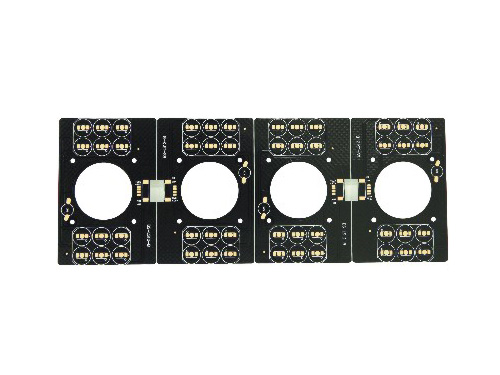
1. Negative-film LED aluminum substrate: due to the presence of side etching, the precision of the drawn lines must be sufficient, so a certain process compensation must be made during negative-film drawing. The determination of the process compensation value must be based on measurements of the side-etching values of copper of different thicknesses. The negative is the negative;
2. LED aluminum substrate preparation: try to purchase a board with a fixed size of 300×300 mm, with a protective film on both the Al surface and the Cu surface. The dielectric constant is the same as on the drawing;
3. LED aluminum substrate pattern: chemical micro-etching is recommended for copper surface treatment, which gives the best results. After the copper surface treatment, screen-print the wet film immediately after drying to prevent oxidation. After development, use a scale magnifier to measure whether the line width and spacing meet the drawing requirements, ensuring the lines are smooth and free of saw teeth. If the aluminum substrate thickness is greater than 4 mm, it is recommended to remove the drive rollers on the developing machine to prevent the board from being returned;
4. LED aluminum substrate etching: use an acidic CuCl-HCl series solution for etching. Use a test board to adjust the solution, etch the Al substrate when the etching effect is optimal, and place the pattern face down to reduce the amount of side etching;
5. LED aluminum substrate surface treatment (immersion tin plating): after etching is completed, do not rush to strip the film; immediately prepare the immersion tin solution, i.e., strip the film and then immediately apply immersion tin, which gives the best results;
6. Machining: when machining the shape, a CNC milling machine should be used to separate the PTFE and aluminum substrate parts. This avoids delamination caused by differences in thermal conductivity and deformation. Keep the front side up to reduce delamination and burrs.
LED aluminum substrate product projects cover the lighting products of the whole industry, such as commercial lighting and indoor lighting. Overall, LED aluminum substrates will continue to develop and grow rapidly in the coming years! As an LED aluminum substrate manufacturer, we are always ready to meet new challenges!












