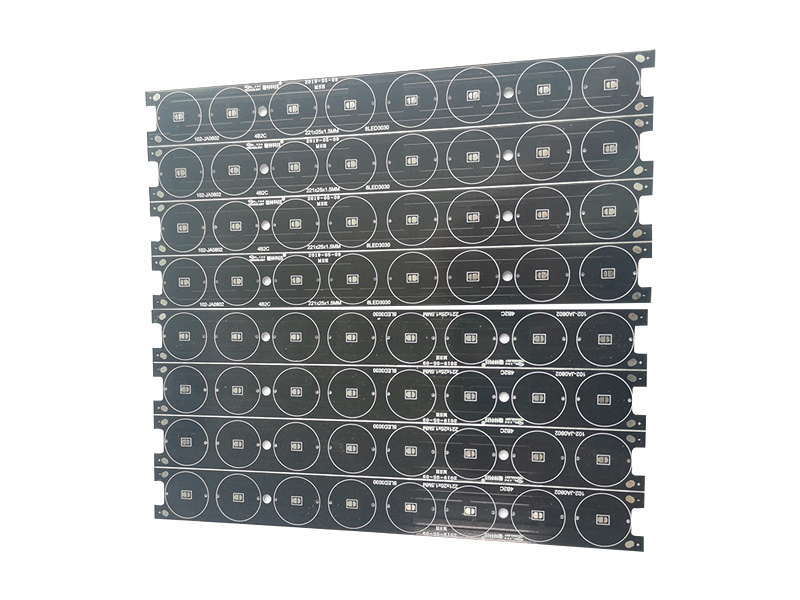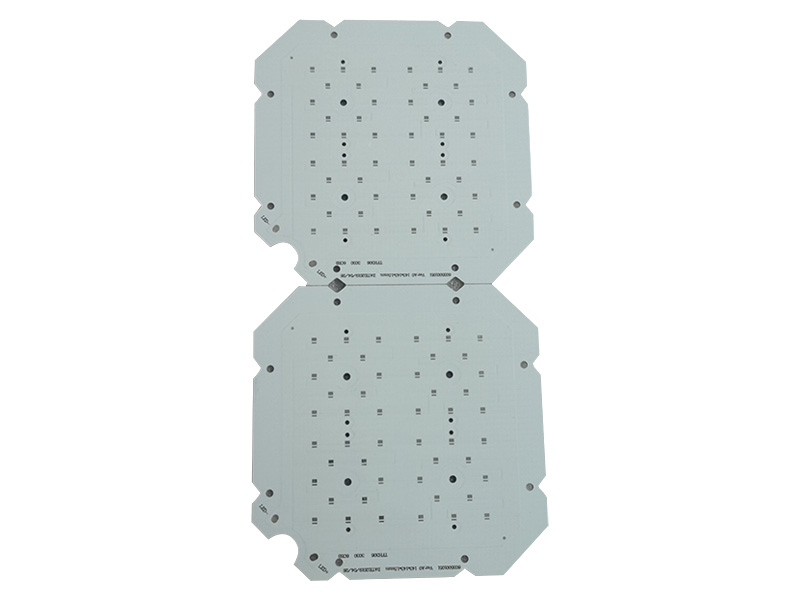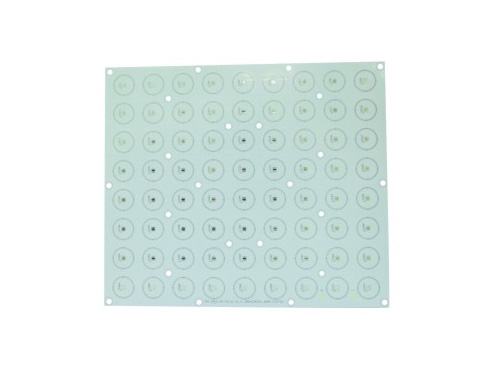
1. Film (phototool) production: because edge etching occurs and the drawing precision must be consistent, a certain process compensation must be applied to the lightly drawn negative; the compensation value must be determined by measuring the edge-etching values of copper of different thicknesses. A negative is a negative.
2. Material preparation: procure aluminum sheet in a fixed size of 300 × 300 mm as far as possible; both the aluminum sheet and the copper sheet surfaces must have a protective film. The dielectric constant should match the drawing.
3. Pattern formation: chemical micro-etching of the copper surface is recommended for the best results. Immediately after the copper surface treatment, dry and screen-print the wet film to prevent oxidation. After developing, measure the line width and spacing with a graduated magnifier to ensure smooth lines without jagged edges. If the UFO aluminum substrate is thicker than 4 mm, it is recommended to remove the drive roller of the developer to avoid rework caused by board sticking.
4. Etching: use an acidic cupric chloride solution for etching. Adjust the solution with a test board, and etch the aluminum substrate under the conditions where the etching effect is best.
5. Surface treatment (tin immersion): after the etching process is complete, do not rush to strip the film. Prepare the immersion tin solution immediately, that is, strip the film and then immerse in tin.
6. Machining: during forming, a CNC milling machine should be used, and the PTFE (polytetrafluoroethylene) and the aluminum substrate portions should be machined separately to avoid delamination caused by their different thermal conductivity and deformation behavior; the patterned side should also face upward to reduce delamination and burr formation.
The above is an introduction to the key process control points for street light aluminum substrates. If you would like to know more, please feel free to consult us.