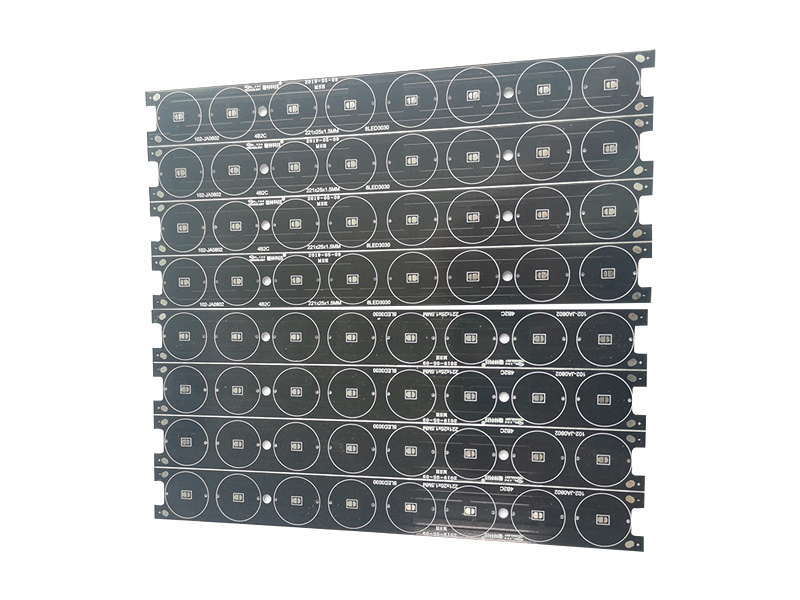
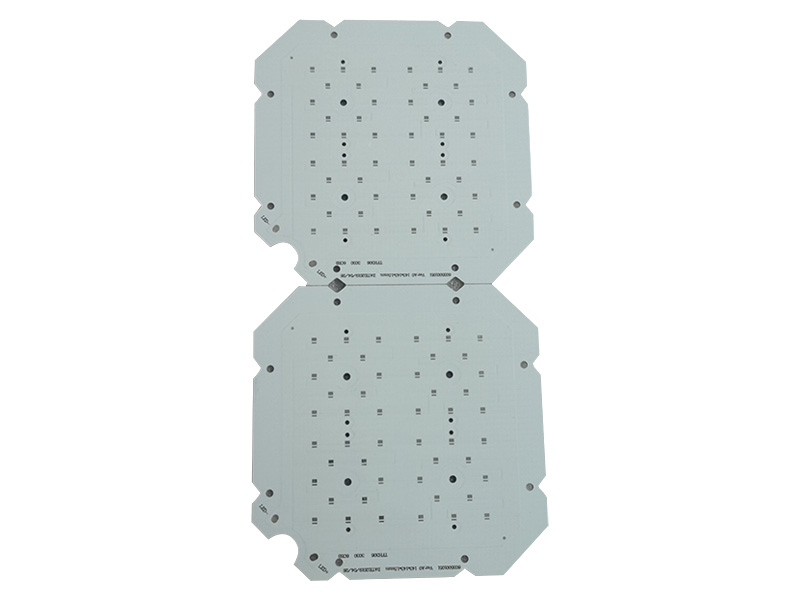
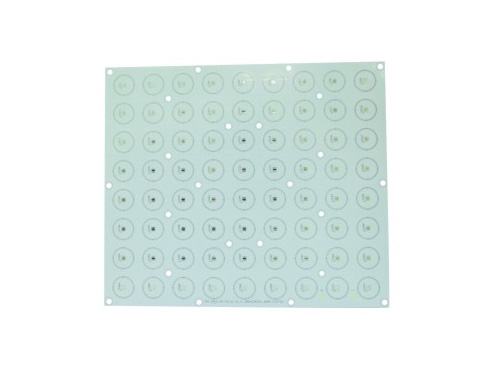
LED aluminum substrates are wired in parallel or in series to achieve better heat dissipation. For instance, a 1 W LED aluminum substrate is already a high-power device with a thermal pad on its bottom; it is best to cover the thermal pad with copper too, and the positive and negative traces can be made relatively narrow, which improves heat dissipation.
In addition, for parallel-connected LED aluminum substrates, a current-limiting resistor should be added in series in each branch to reduce the current differences between branches caused by the different forward voltage drops of the LEDs. Of course, the drawback is high power consumption. It is recommended either to connect all LEDs in series, or to divide them into multiple branches, each driven by its own DC/DC constant-current source.
Over the past two years, high-power LED lighting has followed the trend of energy saving and environmental protection and has grown rapidly, injecting strong momentum into the fast growth of aluminum substrates, so that an aluminum substrate boom has swept across the country.
In fact, LEDs have been used in the market for a long time, with their applications mainly concentrated in palmtop computers (PDAs), mobile phones and other consumer electronics markets. These products have a relatively short lifespan, so the lifespan of the LED is not a major issue, because these products are already discarded or obsolete before the LED reaches the end of its life.
As LED design and process technology continue to advance, LED brightness keeps increasing so that LEDs can compete with incandescent lamps, fluorescent lamps and even halogen lamps. Like most electronic devices, heat is also the greatest threat to LEDs.
Although most people think LEDs do not generate heat, in fact, relative to their size, the heat LEDs generate is considerable. Heat not only affects the brightness of the LED but also changes the color of the light, and ultimately leads to LED failure.
Therefore, preventing the accumulation of heat in LEDs is becoming increasingly important. The key to maintaining sustained high brightness of LEDs over a long period is the use of the most advanced thermal management materials, and using high-thermal-conductivity LED aluminum substrates is one of the important factors.