Product Details
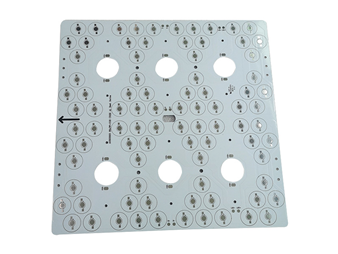
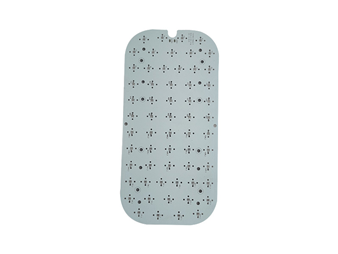
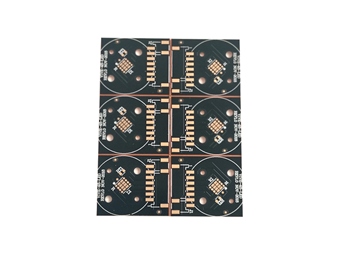
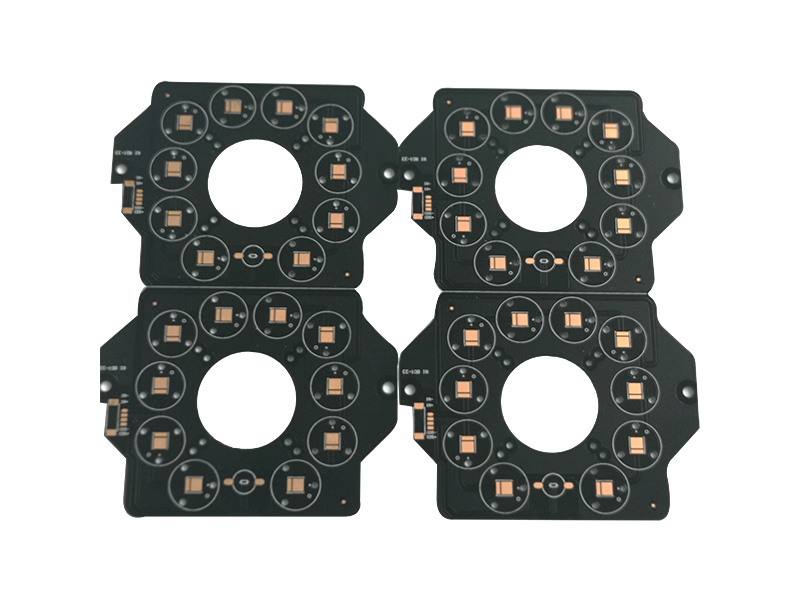
Security plant lighting aluminum substrateWhat is its main function? I believe many people outside the industry are not very familiar with it. Let's learn from it below.
During the testing process of LED chips, many manufacturers tend to overlook the testing of chip pressure. Because during the pressurization process, there is a high possibility of the light dying out. In LED, several factors determine whether the beads will die. This article will introduce the influencing factors of aluminum substrates for security plant lighting. Interested friends come and take a look.
Security plant lighting aluminum substrate is a metal composite board with good heat dissipation performance. Generally speaking, a panel consists of three layers, namely the circuit layer (copper foil), the insulation layer, and the metal substrate layer.
A capacitor composed of two parallel metal plates and an intermediate dielectric. The larger the area of the plates, the smaller the spacing between them, and the larger the capacitance. The insulation layer in the middle of the aluminum substrate is equivalent to a capacitive dielectric, and its thickness cannot be changed after the finished product. The withstand voltage of the insulation layer is generally around 2.5kV, with higher levels around 4kV. The aluminum substrate selected based on cost performance will be designed with a comprehensive consideration of its performance. Generally speaking, if the driving power supply has a sufficiently high withstand voltage (such as 3KV or above), most of the high voltage value can be added to the power supply to make the aluminum substrate withstand lower high voltage.
The method to achieve this goal is to increase the area of the aluminum based copper foil to maximize the distributed capacitance. The specific requirement is to make the total area of the positive copper foil as larger as possible than that of the negative electrode, while ensuring sufficient creepage distance. Generally, the creepage distance of a 2.5kV aluminum substrate is not less than 2.5mm. This ensures that there are no weak links on the aluminum substrate and that it will not break down at higher voltages. Figure 1 shows the aluminum substrate of the mass-produced T8 LED tube. The isolated power supply is 3.75kV, the input line is 5kV, and the withstand voltage of the entire lamp can reach 4kV. During the production process, the withstand voltage performance of the entire lamp was tested on 1.5kV and almost dead lamp beads.
From the above analysis, it can be seen that if a small capacitor can be added between the positive electrode of the security plant lighting aluminum substrate and the aluminum plate (shell), the dead light phenomenon of LED can be significantly improved.
Online Inquiry
Recommended Products